Abstract
Aligning text-to-video diffusion models with human preferences is crucial for generating high-quality videos. Existing Direct Preference Otimization (DPO) methods rely on multi-sample ranking and task-specific critic models, which is inefficient and often yields ambiguous global supervision. To address these limitations, we propose LocalDPO, a novel post-training framework that constructs localized preference pairs from real videos and optimizes alignment at the spatio-temporal region level. We design an automated pipeline to efficiently collect preference pair data that generates preference pairs with a single inference per prompt, eliminating the need for external critic models or manual annotation. Specifically, we treat high-quality real videos as positive samples and generate corresponding negatives by locally corrupting them with random spatio-temporal masks and restoring only the masked regions using the frozen base model. During training, we introduce a region-aware DPO loss that restricts preference learning to corrupted areas for rapid convergence. Experiments on Wan2.1 and CogVideoX demonstrate that LocalDPO consistently improves video fidelity, temporal coherence and human preference scores over other post-training approaches, establishing a more efficient and fine-grained paradigm for video generator alignment.
Motivation
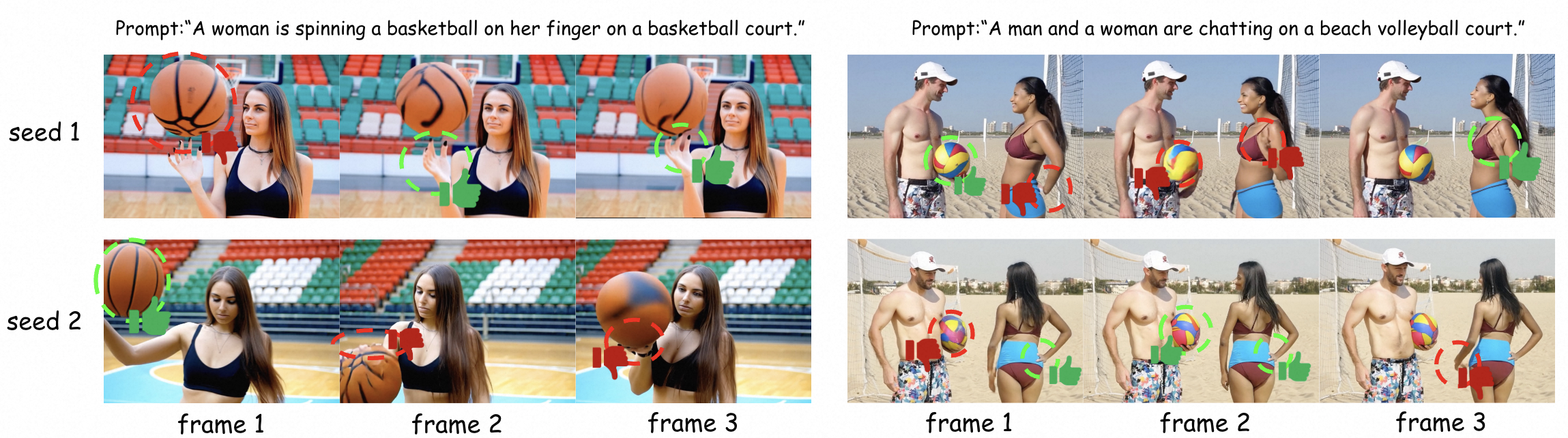
Comparison of video pairs generated by CogVideoX-5B from the same prompt but different seeds reveals significant discrepancies in the visual quality of localized regions, with their relative quality varying across frames. These fine-grained, localized preference patterns are overlooked by the vanilla DPO annotation paradigm, motivating our LocalDPO approach.
Overview
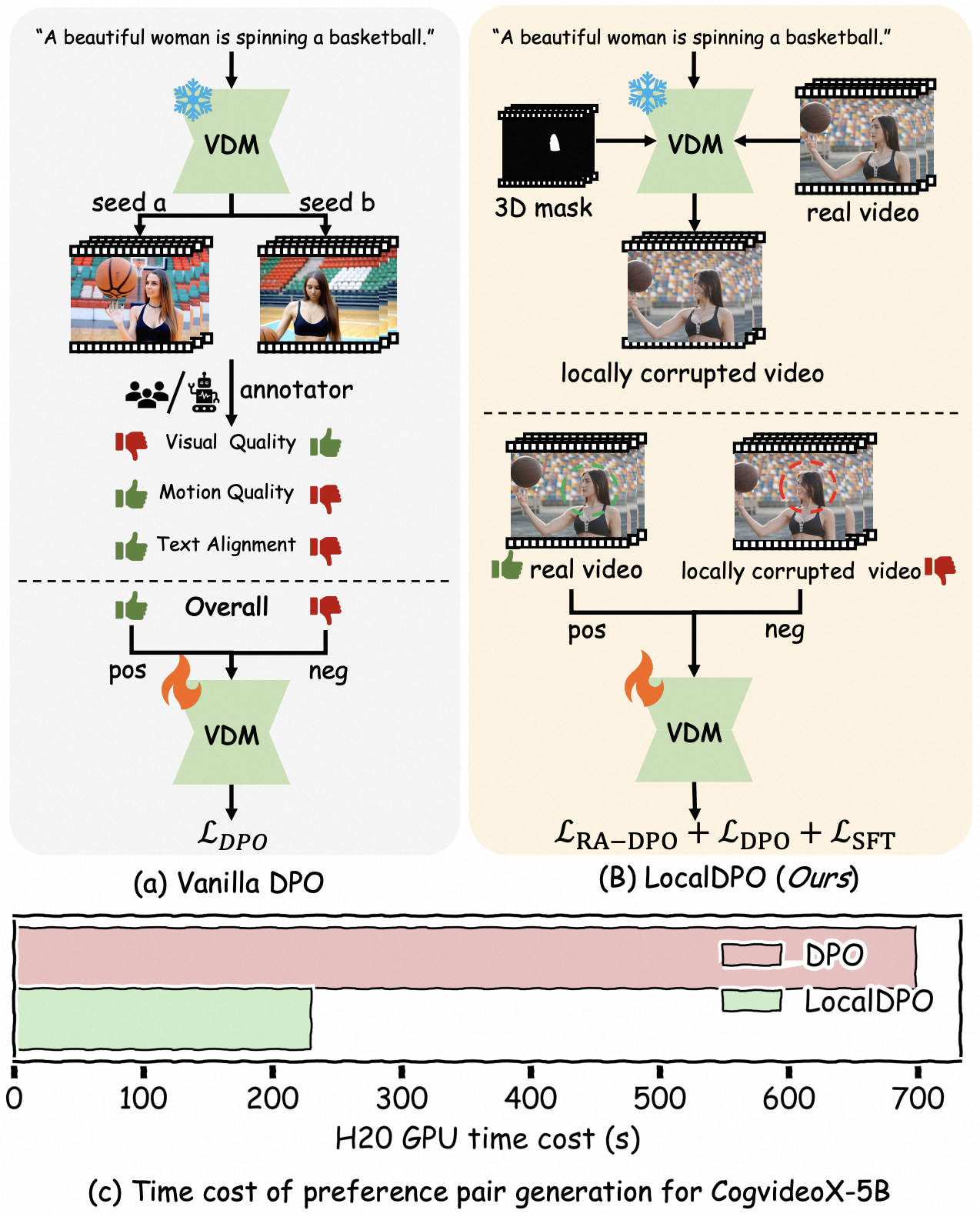
Comparison between (a) vanilla DPO and (b) LocalDPO for video diffusion model (VDM). LocalDPO efficiently constructs positive-negative pairs by locally corrupting real videos, avoiding multi-round sampling, extra critic models, and annotation ambiguities. (c) Quantifies comprison of GPU time in constructing preference pairs.
The main contributions of this paper are summarized as follows:
- 1. We propose LocalDPO, a novel preference optimization method that builds training pairs from real videos and their locally corrupted versions, bypassing costly multi-sample generation and annotations in existing methods. The negative samples are homologous with model and each preference pair is high-confidence.
- 2. We propose a mask-guided local region-aware DPO loss to enable fine-grained preference learning on region-level degradations while preserving global coherence.
- 3. Extensive experiments show that LocalDPO outperforms pre-trained VDMs, SFT, and existing preference-based methods, producing videos with higher visual fidelity, fewer temporal artifacts, and stronger alignment with input prompts quantitatively and qualitatively.
LocalDPO
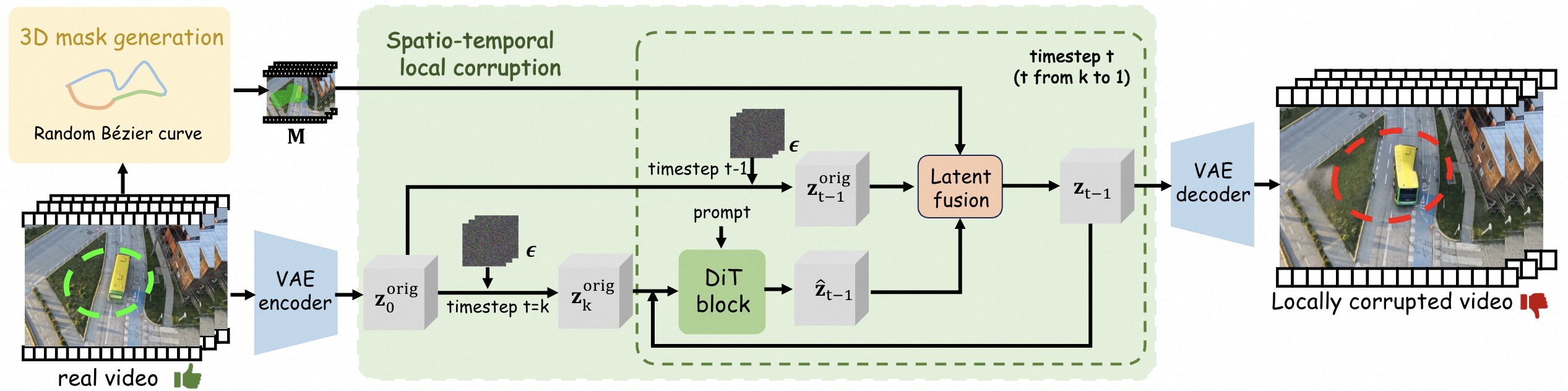
We first randomly sample several Bézier curves on the original video and ensure that these curves form closed shapes. The interior of each closed shape defines the region to be corrupted in subsequent steps. Then, the masked area of real video is inpainted by the pretrained VDM. Specifically, given the latent of input real video, the model first adds a controlled amount of noise to its latent representation and then denoises it step by step. During each denoising step, the original video latent is re-noised at the noise level corresponding to the next timestep and then fused with the denoised latent via a latent fusion mechanism by zt-1 = M ⊙ ẑt-1 + (1 - M) ⊙ zorigt-1 .
Visualization between The Real Video and The Corrupted Video
Compared to the real video, the corrupted video by our method exhibits noticeable degradation and artifacts in local regions.
Quantitative Experimental Results
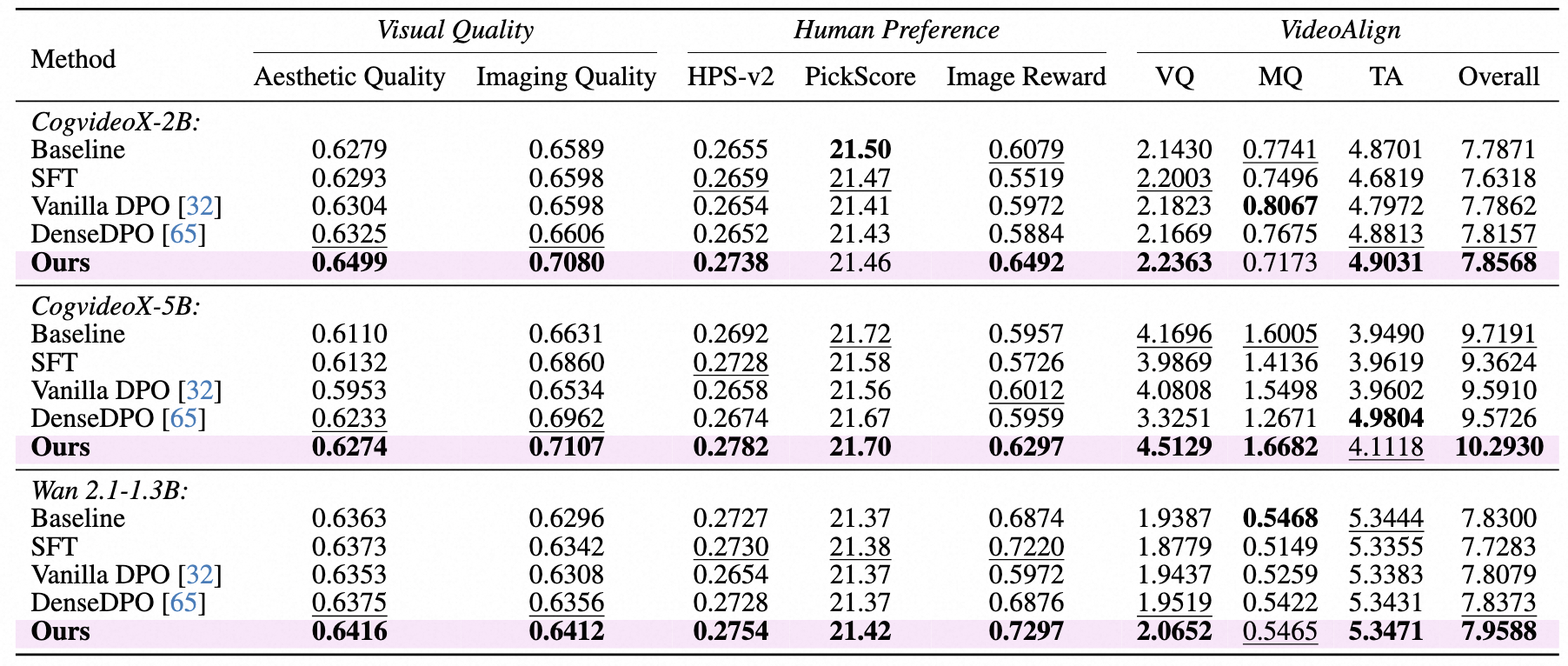
Quantitative Comparison on Vbench prompts from aesthetic and imaging quality dimensions. The best result is highlighted in bold and the second-best is underlined.
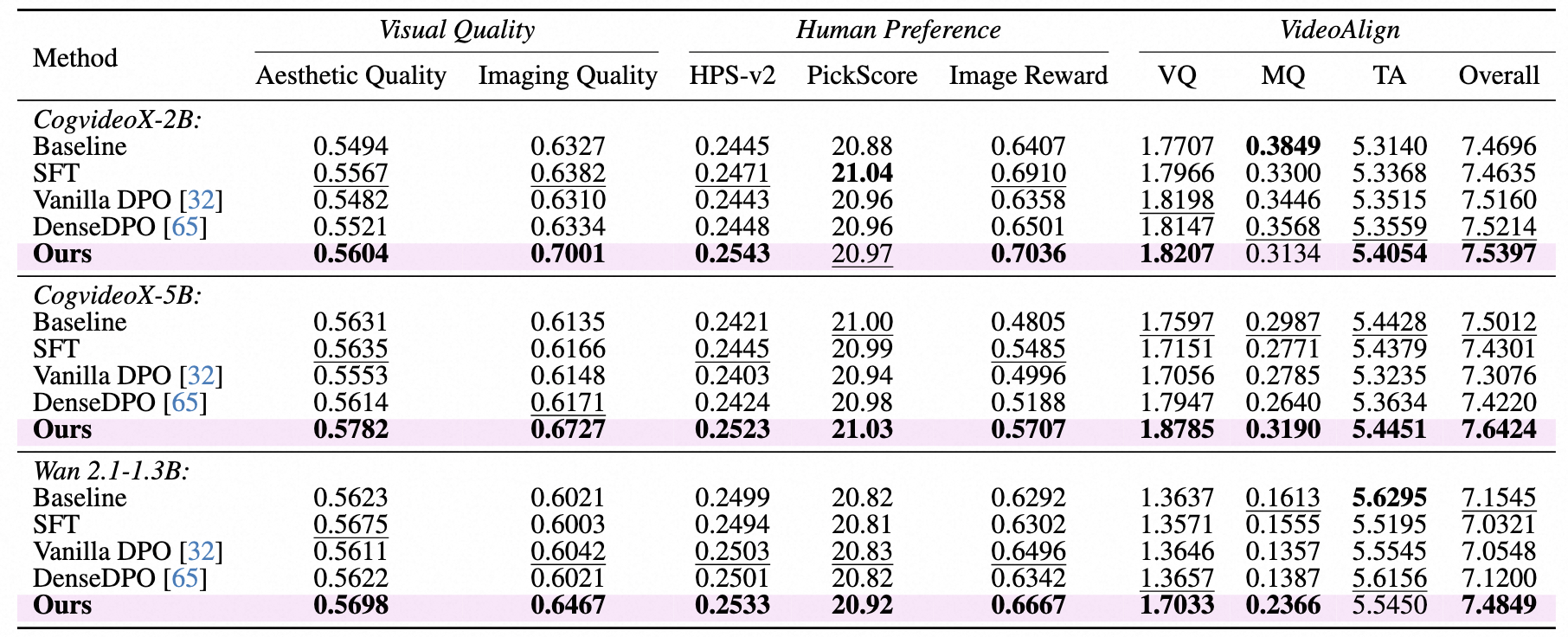
Quantitative Comparison on VideoJAM prompts from aesthetic and imaging quality dimensions. The best result is highlighted in bold and the second-best is underlined.
Human Evaluation
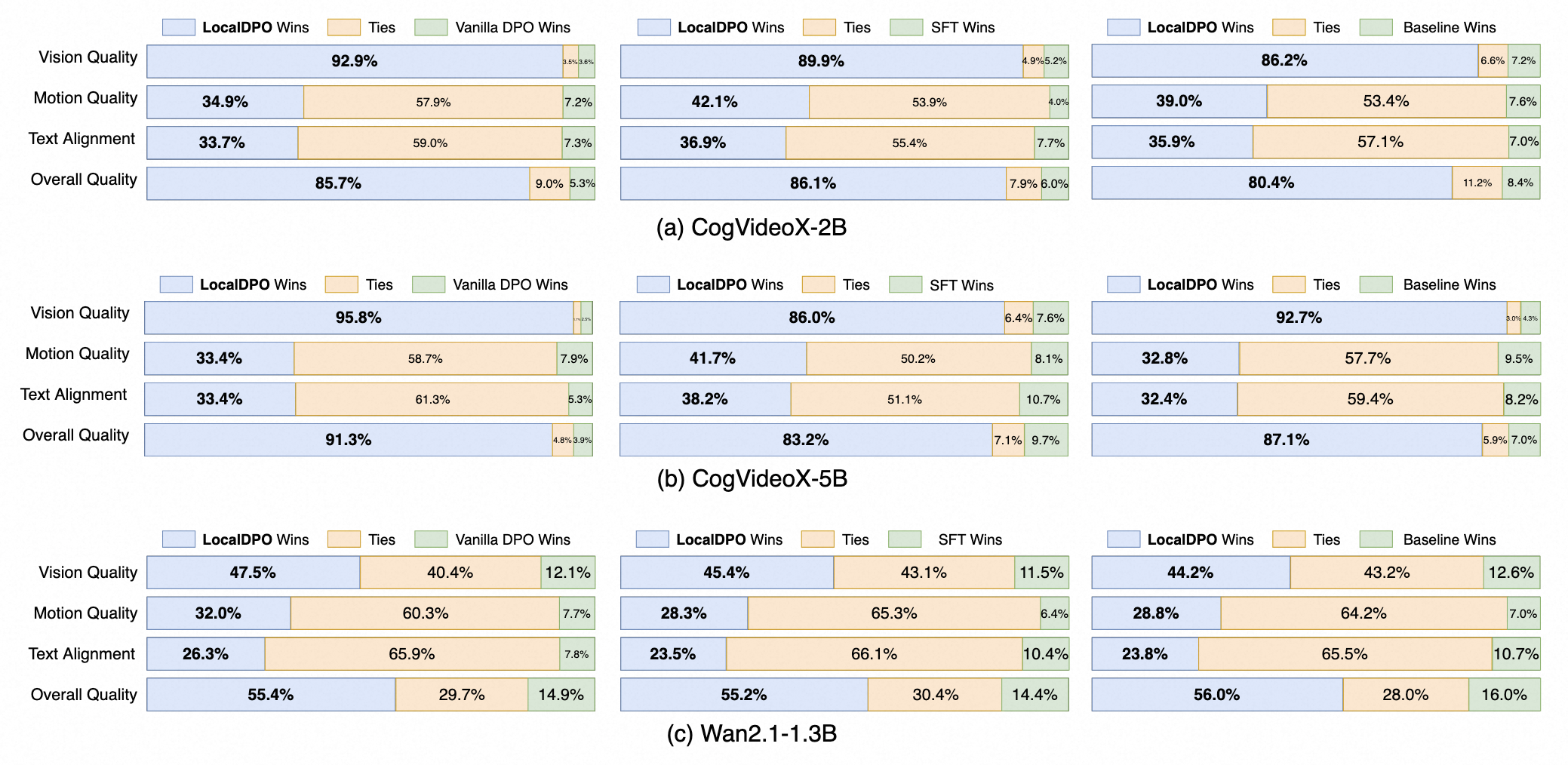
Human evaluation of LocalDPO vs baseline, SFT and VanillaDPO. LocalDPO achieves the best results on all dimensions of human evaluation.
BibTeX
@article{huang2026mind,
  title={Mind the Generative Details: Direct Localized Detail Preference Optimization for Video Diffusion Models},
  author={Huang, Zitong and Zhang, Kaidong and Ding, Yukang and Gao, Chao and Ding, Rui and Chen, Ying and Zuo, Wangmeng},
  journal={arXiv preprint arXiv:2601.04068},
  year={2026}
}